Thoughts on data science, statistics and machine learning.
On the Linearity of Bayesian Classifiers
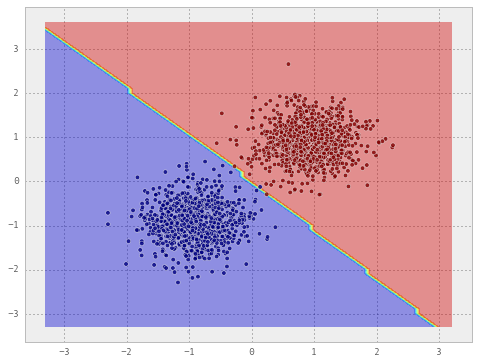
In his book, Neural Networks - A Comprehensive Foundation, Simon Haykin has an entire section (3.10) dedicated to how perceptrons and Bayesian classifiers are closely related when operating in a Gaussian environment. However, it is not until the end of the section that Haykin mentions that the relation is only limited to linearity. What is interesting about this is that a Perceptron can produce the same classification “model” as a Bayesian classifier, provided that the underlying data is drawn from a Gaussian distribution. This post is an experimental verification of that.
A Geometric Proof of the Perceptron Convergence Theorem
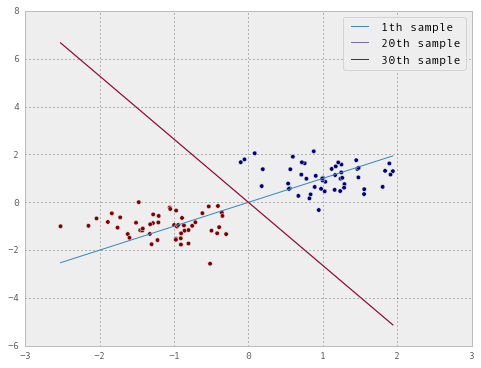
The last time I studied neural networks in detail was five years ago in college. I did touch upon backpropagation when Andrew Ng’s machine learning MOOC was offered on Coursera for the first time, but beyond that I’ve only dabbled with them through keras. Then recently, when I read about Coursera’s imminent decision to pull down much of their freely available material (you can read a rant about it here), I went on a downloading spree (many thanks to the wonderful coursera-dl). Of all the courses I downloaded, the one that caught my eye was Geoffrey Hinton’s course on Neural Networks for Machine Learning. Because of that and the fact that there were some computer vision projects going on at work, I decided to dive right in.
Understanding Allen Downey's Solution to the M&M Problem
Allen Downey makes a very good case for learning advanced mathematics through programming (Check the first section of the preface of Think Bayes, titled “My theory, which is mine”). But before the reader can hit paydirt with using the Bayes theorem in programming, Downey makes you go through some elementary problems in probability, which have to be solved by hand first, if you expect to have a clear enough understanding of the concept. I can vouch for this way of learning complex concepts. The way I learnt the backpropagation algorithm (and its derivation), was with a pen, paper and a calculator.
Evangelism in Foss
One of the most dangerous things that can affect any FOSS community is the tendency of evangelism for the sake of evangelism. Promoting the Python stack, expanding the userbase, etc, should come only as a consequence of the content we produce as developers. If evangelism even remotely becomes one of your goals, your quality is sure to suffer. And it’s not just the empirical evidence that prompts me to say this. It even makes logical sense. If we want to “promote” Python and related tech, our best market would be the young and unexperienced (and therefore non-opinionated) minds. But note that such audiences are also very fickle. They may not return for the next conference. And since they don’t, we have to count on more fresh entries each year. And in the conference itself, since we’re all acutely aware of the demographic, we spend too many talks pandering to this part of the audience.