Thoughts on data science, statistics and machine learning.
Organizing a Bookshelf with Multivariate Analysis
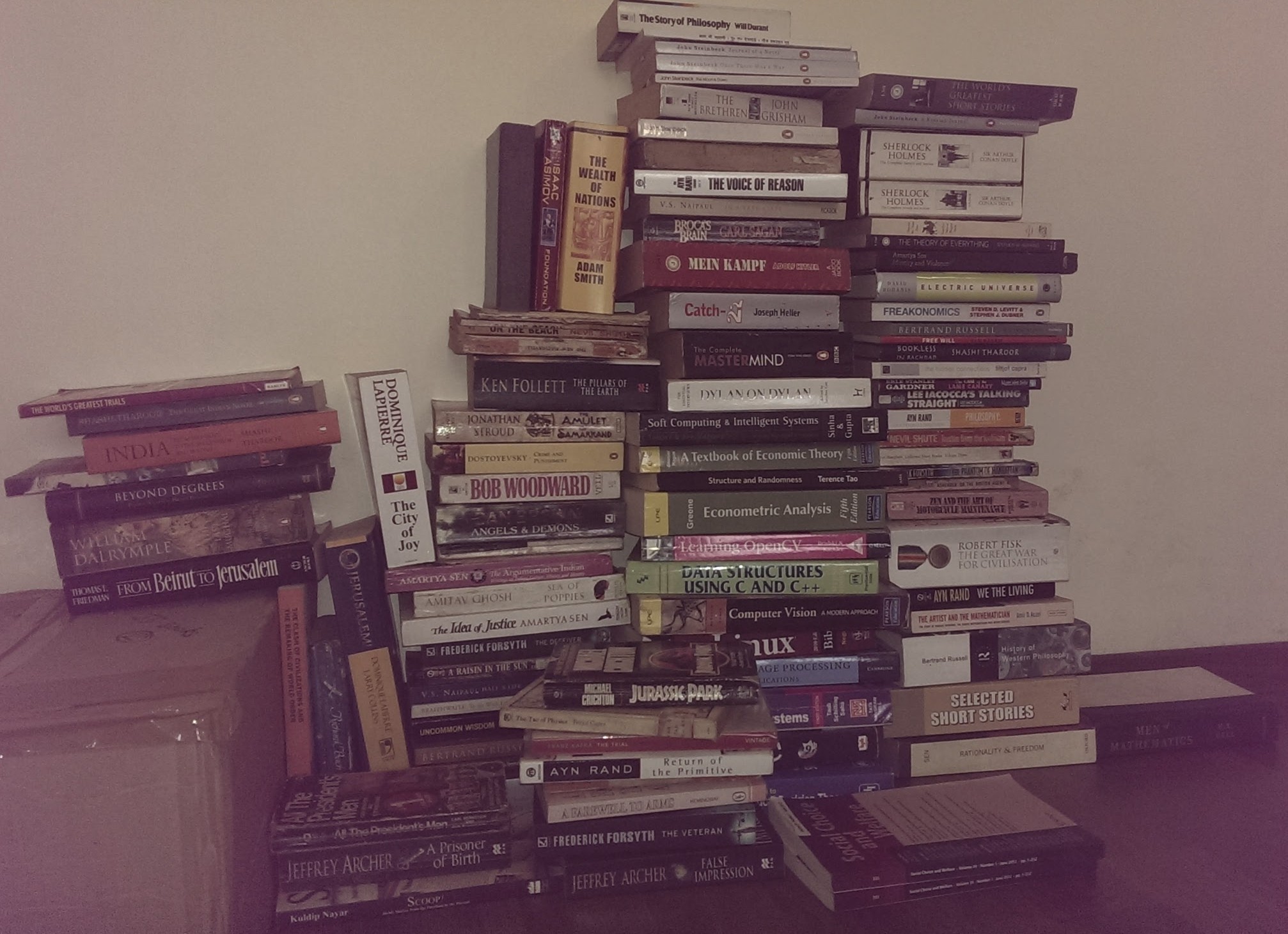
I have recently moved from Pune to Delhi. I had spent only a year in Pune, having moved there from Mumbai, where I lived for three years. Whenever I move, the bulk of my luggage consists of books and clothes. My stay in Pune was just a transition, so I never bothered to unpack and store all my stuff too carefully. Thus, a corner of my bedroom in my Pune apartment always looked like this:
Limitations of the Fourier Transform
My implementation of the Hilbert Huang transform (PyHHT) is quite close to a beta release. After nearly three years of inactivity, I’ve found some time to develop the PyHHT library in the last few weeks. In all this time many people have written to me about a lot of things - from the inability to use the module because of the lack of documentation, to comparison between the results of HHT and conventional time series analysis techniques. And now the time has come when I can no longer avoid writing the documentation. But as I write the documentation, I’ve found that I need to re-learn the concepts which I learned back when I started writing this module. It is out of this learning cycle that came my last blog post.
Edge Effects in Empirical Mode Decomposition
It has been a little over three years since I started working on a Python implementation of the Hilbert Huang Transform. When I first presented it at SciPy India 2011 (video) it was just a collection of small scripts, without packaging, testing or even docstrings. Over time PyHHT has garnered some interest, and I have, since the last few weeks, found the time to regularly work on it. I have been able to come up with a decent implementation of empirical mode decomposition, pretty much in line with everything described in the original paper by Huang et al. The other parts of HHT, like the Hilbert spectrum and its time frequency representations are right around the corner.